
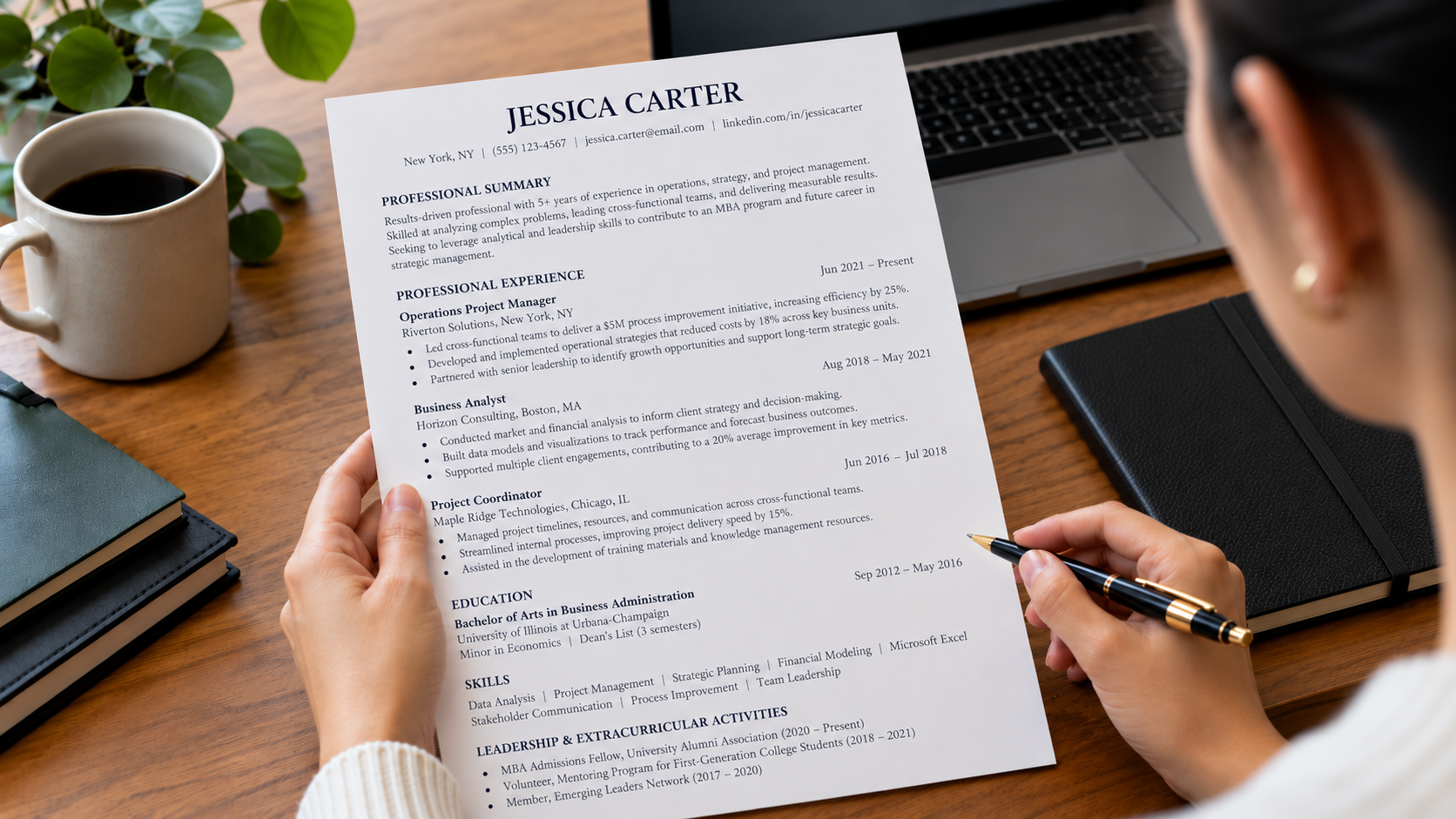
An MBA resume should highlight your career progression, leadership experience and most important professional achievements. For most traditional MBA applications, aim for one page, use a simple format and focus on results rather than job responsibilities.
Unlike a resume written for a specific job vacancy, a business school resume helps admissions committees understand your professional journey, how your responsibilities have grown and the impact you have made.
The strongest approach is to organize your experience clearly, select your most meaningful accomplishments and support them with specific evidence.
MBA Resume: What to Include
A clear structure makes your experience easy to evaluate.
| Section | What to include |
|---|---|
| Contact information | Name, email, phone and location |
| Professional experience | Employers, roles, dates, promotions and achievements |
| Education | Degrees, institutions, dates and relevant honors |
| Leadership and activities | Meaningful community, volunteer or extracurricular involvement |
| Additional information | Relevant certifications, languages or distinctive interests |
For applicants with substantial work experience, professional achievements should usually occupy the largest section.
However, recent graduates may place education first.
Avoid filling space with generic skill lists that provide little evidence of your abilities.
How Long Should an MBA Resume Be?
One page is the safest starting point for most traditional MBA applicants.
Wharton’s MBA application guide explicitly requires a one-page resume submitted as a PDF.
Similarly, MIT Sloan’s MBA application instructions require one page.
Stanford GSB also requests a one-page business resume unless applicants have a compelling reason to use more space, such as extensive work experience.
However, requirements can differ for Executive MBA programs and other specialized degrees.
Always follow your target school’s instructions rather than assuming every program uses the same limit.
Keep the Layout Simple
Use a professional, readable format with clear headings and consistent spacing.
A straightforward structure typically works better than elaborate graphics or multiple columns.
For most applications:
- Use reverse chronological order.
- Make employers, job titles and dates easy to identify.
- Choose a readable font and consistent formatting.
- Use concise bullet points.
- Avoid photographs unless specifically requested.
- Submit the required file format.
Never reduce text until it becomes difficult to read merely to fit another accomplishment.
MBA Resume vs Job Resume: Key Differences
A conventional job resume emphasizes qualifications for a particular position.
An MBA resume has a broader purpose: showing how you have developed professionally and what you could contribute to business school.
For example, a software engineer applying for a technical position may highlight programming languages, systems and development tools.
For an MBA application, the more valuable evidence might be leading a cross-functional project, influencing business decisions or improving customer outcomes.
Technical expertise remains relevant, but its business significance should be understandable.
Admissions committees also consider your essays, recommendations and interviews. Therefore, your resume does not need to tell your entire personal story.
Instead, use it to establish the facts and strongest accomplishments.
How to Write an MBA Resume Step by Step
Building a strong resume starts with selecting evidence, not designing the page.
Step 1: List Your Professional Achievements
Before editing, create a separate list of your important contributions.
Consider projects where you:
- Increased revenue or reduced costs
- Improved a process or product
- Led a team or initiative
- Managed substantial budgets
- Resolved a difficult problem
- Influenced stakeholders
- Earned a promotion
- Helped develop colleagues
Then identify the accomplishments that best demonstrate progression, initiative and impact.
You do not need to include everything you have done.
Step 2: Make Career Progression Visible
Show promotions clearly, particularly when you have advanced within one company.
For example:
Northstar Technologies — Boston, MA
- Operations Manager | 2024–Present
- Senior Analyst | 2022–2024
- Analyst | 2020–2022
This format makes increasing responsibility immediately visible.
Give more detail to recent, substantial positions. Earlier roles can usually be shorter.
If an employer is unfamiliar, briefly explain its industry, size or business model.
Step 3: Turn Responsibilities Into Achievements
Weak resume bullets describe duties.
Stronger bullets explain what you accomplished.
Weak example:
“Responsible for improving customer onboarding.”
Stronger example:
“Led a six-person team to redesign customer onboarding, reducing average implementation time from 42 to 29 days.”
The second example explains your contribution and the result.
A useful writing formula is:
Action + context + individual contribution + result
For instance:
“Negotiated new supplier agreements across three markets, reducing annual purchasing costs by $420,000.”
These are hypothetical examples. Use only achievements and figures that accurately reflect your own work.
Step 4: Quantify Meaningful Results
Numbers can help admissions readers understand scale.
Useful metrics include revenue, savings, efficiency, team size, budgets and project timelines.
However, not every achievement needs a percentage.
For example:
“Persuaded senior leadership to revise a restructuring plan after identifying operational risks.”
This demonstrates judgment and influence without invented figures.
Stanford’s application guidance encourages candidates to explain both their results and how they achieved them.
Therefore, avoid listing impressive numbers without explaining your contribution.
Step 5: Edit for Relevance
Once your accomplishments are written, remove weaker material.
Give priority to achievements that reveal leadership, analytical ability, initiative, collaboration and career progression.
Cut repetitive descriptions of daily tasks.
Finally, check whether someone unfamiliar with your industry could understand your professional impact.
MBA Resume Examples: Effective Bullet Points
Here are several hypothetical examples that show different types of achievement.
| Experience | Example of a strong bullet |
|---|---|
| Operations | Reduced production delays by 18% through a new scheduling process |
| Finance | Built an investment model supporting a $12 million expansion decision |
| Marketing | Redesigned acquisition campaigns, increasing qualified leads by 24% |
| Technology | Led eight engineers through a product launch delivered ahead of schedule |
| Healthcare | Coordinated a cross-department initiative to improve patient discharge processes |
| Nonprofit | Organized 35 volunteers to expand community mentoring services |
Specificity helps, but accuracy matters more than impressive figures.
If you contributed to a team result, make your individual role clear without taking credit for someone else’s work.
How to Demonstrate Leadership Without a Management Title
You do not need to supervise employees to show leadership potential.
Business schools may value examples of initiative and influence.
For instance, leadership could involve mentoring new colleagues, coordinating a complex project, resolving a disagreement or convincing senior management to improve a process.
Consider this example:
“Created a mentoring initiative connecting 15 junior employees with experienced colleagues across four departments.”
The accomplishment demonstrates initiative and organizational contribution even without a formal management title.
However, avoid claiming leadership when your involvement was minor.
Explain the responsibility you genuinely held.
Education, Awards and Activities
Include your academic history in a clearly labeled section.
For each relevant qualification, provide the institution, degree and graduation date. Add honors or academic distinctions when meaningful.
You may also include extracurricular activities that reveal additional dimensions of your character.
Examples include:
- Volunteering or community leadership
- Professional associations
- Mentoring programs
- Entrepreneurship
- Competitive sports or creative activities involving sustained commitment
However, activities should add useful information.
A long list of casual interests rarely strengthens an application.
Should You Include Your GPA?
Follow the school’s instructions.
Some universities request GPA separately in the application form. Others may value seeing strong academic performance on the resume.
If your GPA is included, report it accurately and retain its original grading scale when appropriate.
Do not invent conversions or omit information that the application explicitly requires.
Tailoring Your MBA Resume to Different Schools
You do not necessarily need an entirely new resume for every application.
However, schools may have different length, formatting and submission requirements.
Start with a strong master resume containing your most important experiences.
Then adjust it according to each school’s instructions.
For example, Wharton emphasizes professional growth, leadership, teamwork and measurable impact in its published guidance.
MIT Sloan similarly encourages results-oriented bullets rather than basic job descriptions.
The underlying facts should remain consistent across applications.
Do not exaggerate accomplishments or change your career history to match what you think a school wants to hear.
Common MBA Resume Mistakes
Avoid these frequent problems:
- Listing responsibilities instead of achievements: Explain what you changed or accomplished.
- Using vague business language: Replace empty phrases with clear actions.
- Hiding promotions: Make professional progression obvious.
- Inventing metrics: Only use information you can verify.
- Including excessive technical jargon: Make achievements understandable.
- Adding unnecessary personal information: Focus on relevant qualifications.
- Ignoring school requirements: Check length, format and submission rules.
- Repeating the entire essay: Let each application component serve its purpose.
Your resume should also be consistent with your recommendations and other application materials.
For help coordinating them, read our MBA application timeline.
Final MBA Resume Checklist
Before submitting, confirm that your resume:
- Follows the target school’s page limit.
- Uses clear headings and readable formatting.
- Presents employment in reverse chronological order.
- Makes career progression and promotions visible.
- Prioritizes meaningful achievements.
- Explains your individual contributions.
- Uses reliable metrics where useful.
- Includes relevant education and activities.
- Avoids factual errors and unexplained inconsistencies.
- Matches the information in your wider application.
Finally, proofread employer names, dates, titles and numerical claims.
Our MBA application essay guide can help you explain the personal motivations and career goals that do not belong in a concise resume.
MBA Resume: Frequently Asked Questions
Should an MBA Resume Be One Page?
Usually, yes. Several leading business schools require or recommend one page, although individual program requirements vary.
Is an MBA Resume Different From a Job Resume?
Yes. It emphasizes career progression, leadership and impact rather than suitability for one specific vacancy.
Should You Include Every Job?
Include enough employment history to make your progression understandable, but give more space to meaningful and recent experiences.
Can You Include Volunteer Leadership?
Yes. Relevant community involvement can demonstrate initiative, responsibility and contributions outside work.
Do You Need Numbers in Every Bullet?
No. Quantify results when the figures are accurate and meaningful. Strong qualitative achievements also have value.
Should You Use an MBA Resume Template?
A simple template can help, but follow each school’s formatting instructions. Clarity matters more than decorative design.
A strong MBA resume helps admissions committees understand what you have achieved, how your responsibilities have grown and what you could contribute to their program. Focus on evidence, keep the layout readable and include only information that genuinely strengthens your application.